The Story of the Oris Big Crown Pointer Date
Born in 1938 and still unmistakably Oris, the Big Crown Pointer Date has outlived trends, crises and entire eras of Swiss watchmaking.
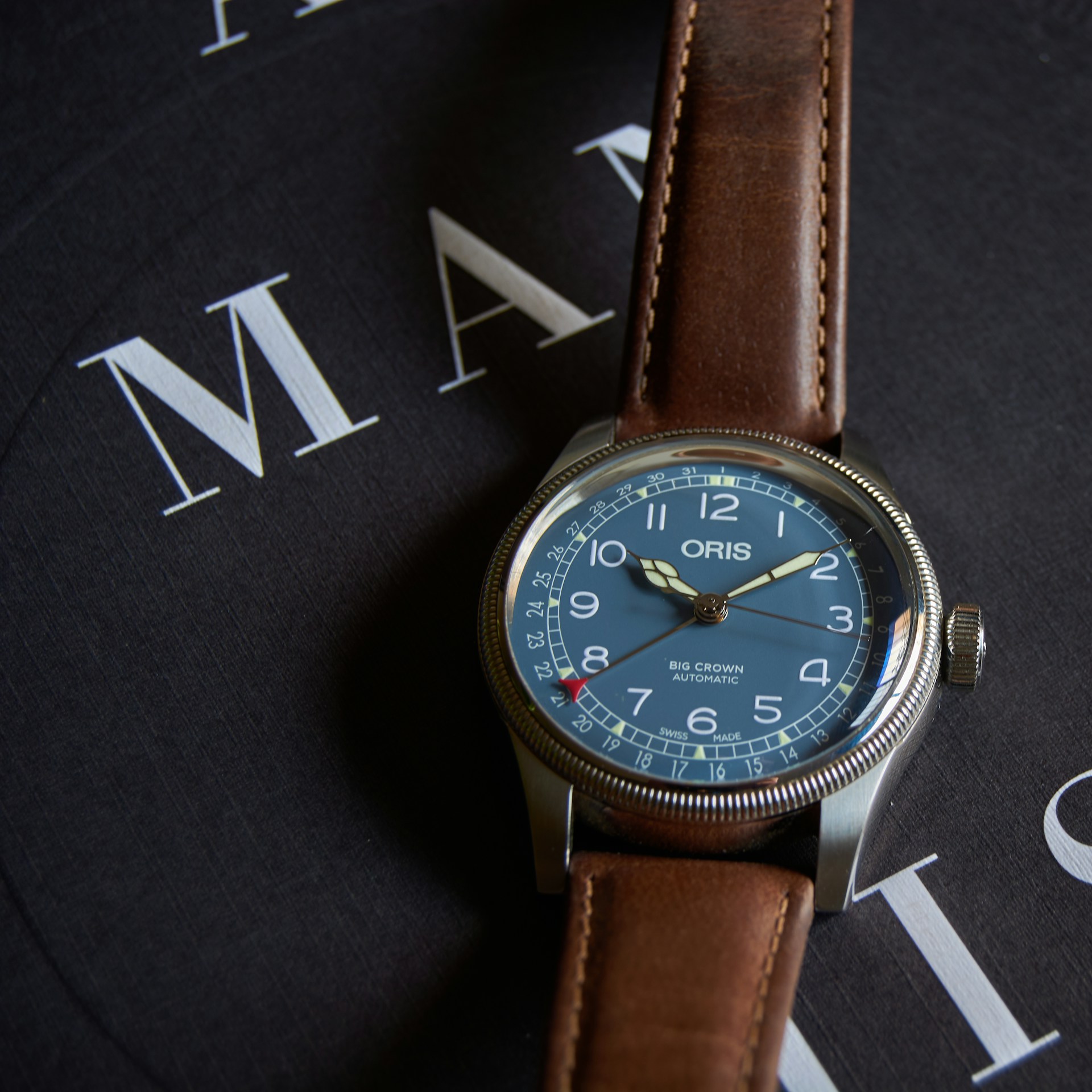
The story of the Big Crown Pointer Date starts long before the watch itself. It begins in the small Swiss town of Hölstein.
In 1904, Paul Cattin and Georges Christian established a new watch company in Hölstein, in the Swiss canton of Basel-Landschaft. They took over an existing watch factory and named their new company Oris, after a nearby stream.
Oris grew quickly. Rather than concentrating exclusively on expensive watches produced in small numbers, the company developed an industrial approach to Swiss watchmaking. Its factories produced watches on a much larger scale, helping Oris grow from a small operation into a significant manufacturer.
By the time the Big Crown appeared, Oris had already spent more than three decades making watches. Aviation was also changing rapidly. Aircraft had become faster and more capable, and the wristwatch had developed into a useful instrument for the people flying them.
The watch that gave Oris a lasting signature
In 1938, Oris introduced a pilot's watch with two details that would eventually become inseparable from the brand: an oversized crown and a pointer calendar.
The large crown had a practical purpose. Pilots could operate it more easily while wearing leather gloves. What now looks like a deliberate piece of vintage styling began as a straightforward solution to a real problem.
The calendar was equally distinctive. Instead of placing the date inside a small window, Oris used a separate central hand that pointed towards a numbered scale around the outside of the dial.
Together, those two features created the basic formula of the Big Crown Pointer Date. More than eighty years later, the same idea remains immediately recognisable.

Before it became a design icon, it was a tool
Looking at a modern Big Crown Pointer Date, it is easy to see its oversized crown as part of the watch's personality. In 1938, the thinking behind it was considerably simpler.
A pilot wearing gloves needed to be able to operate a watch without removing them. Making the crown larger made that easier. The solution was practical, but it also gave the watch a silhouette that was difficult to confuse with something else.
The original requirement has largely disappeared. Most Big Crown owners will never use one in an open cockpit. The design survived because the feature became something more than the problem it was created to solve.
A different way to show something ordinary
There is nothing unusual about a watch displaying the date. The way the Big Crown does it is another matter.
A slender hand extends from the centre of the dial towards a scale numbered from one to thirty-one. As the month progresses, the hand moves around the dial, indicating the date at its outer edge.
The advantage is partly visual. There is no conventional date aperture cutting into the dial. Instead, the calendar becomes part of the overall layout of the watch.
It also gives the Big Crown something that is increasingly difficult to achieve in watch design: an instantly identifiable face. Remove the logo and the combination of the large crown and central pointer-date hand would still give away what you were looking at.
Eight decades is a long time in watchmaking
The world around the Big Crown has changed almost beyond recognition since 1938. Mechanical watches went from everyday necessities to objects bought largely by people who simply appreciate them.
Oris changed too. The company expanded, passed through one of the most difficult periods in the history of the Swiss watch industry and eventually returned to independent ownership in the early 1980s.
What followed helped shape the Oris that exists today. The company increasingly concentrated on mechanical watches, building its modern identity outside the large luxury groups that came to dominate much of the Swiss watch industry.
Against that background, the survival of the Big Crown is significant. It is not a recently invented heritage model built around a forgotten name from an archive. Oris has kept the basic concept alive across generations.
The design never needed to start again
Today's Big Crown family is broader than the watch that appeared in 1938. Oris has experimented with different case sizes, dial colours and materials, and modern versions are available with different mechanical movements.
But the important parts remain easy to find. The crown is still prominent. The date still travels around the edge of the dial. Look at the watch from across a room and the family resemblance is still there.
That continuity is what separates the Big Crown Pointer Date from many modern watches inspired by the past. It does not need to recreate a discontinued design because its own story never really stopped.
The original watch belonged to a world of leather flying gloves and mechanical instruments. The modern Big Crown belongs to a very different one. Somehow, the same two ideas that made sense in 1938 still give the watch its identity today.
The oversized crown began as a practical solution. The pointer date became a signature. Oris kept both.