The Longines Spirit Zulu Time and 100 Years of Dual-Time History
The Spirit Zulu Time is a modern GMT watch, but the story behind it began a century ago with one of Longines' earliest attempts to display two different times on the wrist.
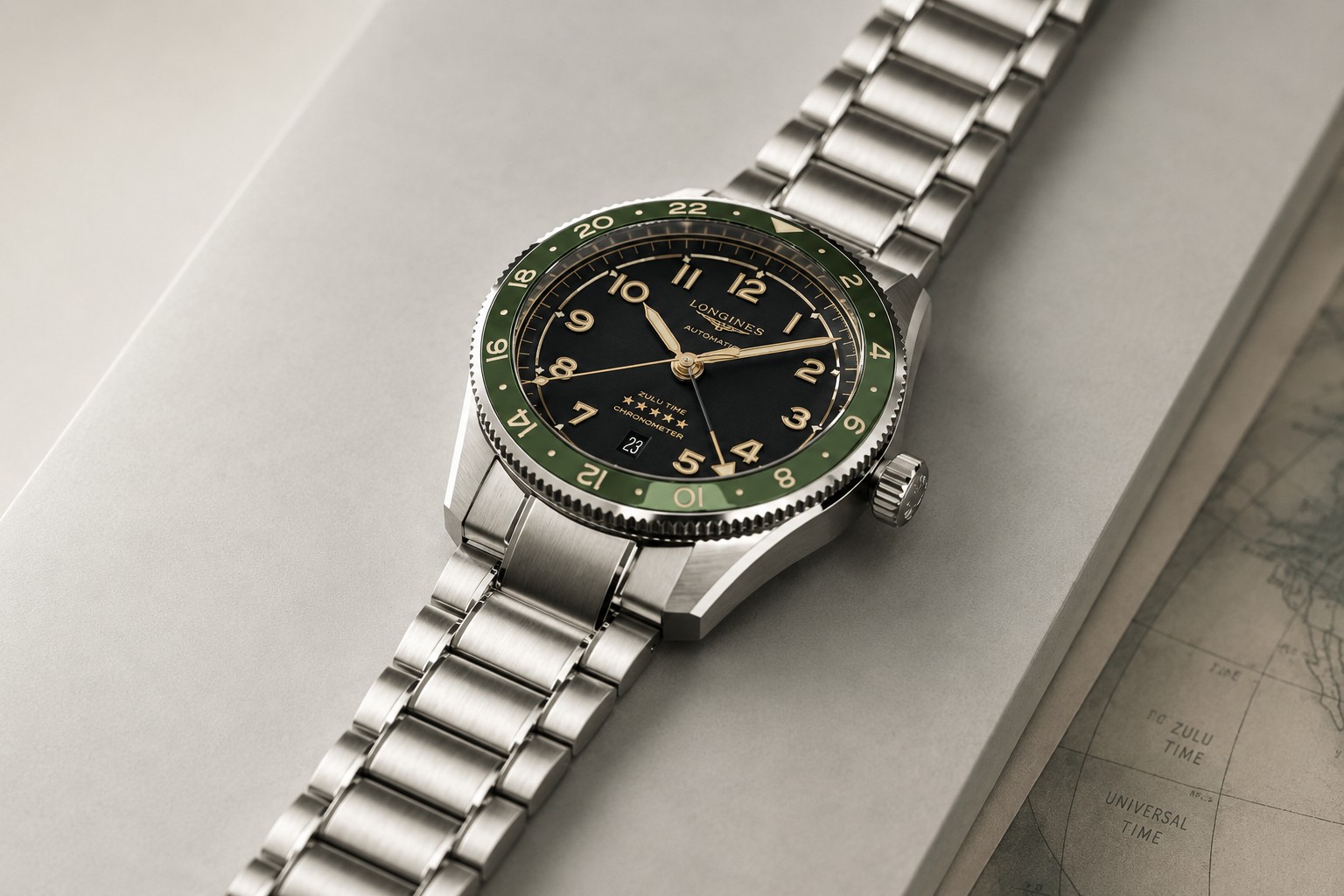
Longines has been working with the idea of multiple time zones for longer than the Spirit Zulu Time itself suggests. In 1925, the company produced a wristwatch capable of displaying two different times. A hundred years later, that early idea became the starting point for the Spirit Zulu Time 1925.
The history is sometimes reduced to a simple claim that Longines made an early GMT watch. That misses an important distinction. Longines describes the 1925 model as its first dual time wristwatch. It was designed to show two time zones, long before the modern idea of a GMT watch had taken its familiar form.
In 2025, Longines marked the centenary of that watch with the Spirit Zulu Time 1925. The anniversary model looks firmly modern, yet its name and purpose make much more sense when viewed against the watch that came before it.
Longines and the problem of keeping time in two places
In 1925, Longines produced a wristwatch that could display two different time zones. According to the company, it was its first dual time wristwatch and it featured a small Zulu flag on the dial.
The world was becoming easier to cross. International travel was still far from ordinary, but aviation and faster transport were beginning to shrink distances between countries. Time, which had always been a local matter, was becoming something people increasingly had to compare across borders.
Longines was already closely involved with aviation and navigation. Accurate timekeeping mattered in both fields, and the ability to follow more than one time zone fitted naturally into that world.
The 1925 watch is most interesting when viewed in its own context. It was not a modern GMT watch in the way we think of one today. It was an early Longines wristwatch built around a practical idea that remains familiar a century later: keeping track of time somewhere else.

One time reference for a world that does not stand still
The name Zulu Time comes from the letter Z. In the phonetic alphabet used in aviation and other international fields, Z is pronounced Zulu.
Zulu Time gives people in different parts of the world a shared reference. Instead of converting between local clocks, a pilot, controller or navigator can work from one agreed time. Today, the term is closely associated with Coordinated Universal Time, better known as UTC.
Aviation made this especially useful. A flight can cross several time zones in a matter of hours. Departure times, weather reports and communication all become easier to coordinate when everyone refers to the same clock.
Longines' connection with the term goes back to 1925. The company's first dual time wristwatch featured a Zulu flag on its dial. That detail would eventually give the modern Spirit Zulu Time its name.
How an old idea found its way into a modern collection
The 1925 watch and the modern Spirit Zulu Time come from very different periods of watchmaking. Their designs, movements and audiences are separated by a hundred years. The connection lies in the problem they were both trying to solve.
The Spirit Zulu Time joined Longines' Spirit collection in 2022. The collection already drew on the company's links with aviation, and the addition of a GMT function gave Longines a natural way to revisit its earlier history with multiple time zones.
The modern Spirit Zulu Time approaches the same idea in a different way. Alongside the local time, its additional GMT hand allows the wearer to follow a second time zone at the same time, using the 24 hour scale around the dial.
The technology has changed considerably since 1925, but the reason behind it remains familiar. Sometimes the time where you are is not the only time you need to know.
That is what makes the Spirit Zulu Time feel connected to the earlier watch. It is not a visual recreation of 1925. Instead, it carries the same basic idea into a completely different era.
Marking one hundred years of dual time history
In 2025, Longines marked one hundred years since the creation of its first dual time wristwatch with the Spirit Zulu Time 1925.
Longines did not try to recreate the original watch. The anniversary model takes the modern Spirit Zulu Time as its starting point and uses it to acknowledge the history behind the collection.
Details such as the anniversary references and rose gold accents set the model apart from the regular collection while keeping it firmly rooted in the present.
That feels appropriate for a centenary. The point is not to make 1925 look like 2025. It is to show how the same interest in time beyond one location has continued through very different periods of watchmaking.
The question behind the watch has not changed
On its own, the Spirit Zulu Time can look like a modern GMT watch with an aviation inspired name. The history behind it gives that name a clearer reason to exist.
Longines can trace its connection with multiple time zones back to a specific wristwatch from 1925. The Zulu flag on that watch provides a direct historical link to the name used by the modern collection.
The watches themselves belong to completely different worlds. One was created when international travel was still developing. The other belongs to a time when crossing several time zones in a single day is routine.
Yet the basic question is still familiar.
What time is it there?
A century separates the first Longines dual time wristwatch from the Spirit Zulu Time 1925. The answer has become more refined, but the reason for asking the question has stayed much the same.